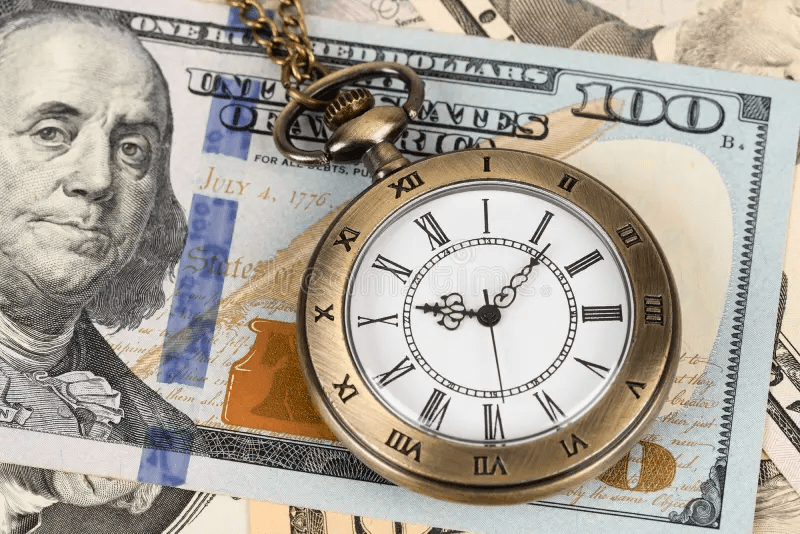
Today, we will be talking about the time value of money. The time value of money makes the argument that any amount of money today is worth more than that same amount tomorrow. The key component here is time. The time value of money is essential in considering the future value of investments, loans and mortgages, retirement plans, and much more.
Interest and Inflation
Let’s start with a basic example: Would you rather receive $100 today or $100 a year from now? If you take the $100 today and decide to put it into an account that has an annual interest rate of 5% or that increases the amount of money in the account by 5% per year, you will have $105 by the time you would have received $100 a year from today. It goes without saying that in our financial system, $105 is more significant than $100.
We have gone over how the time value of money can affect interest rates, but what about other areas of the economy? One of these areas is inflation. In terms of inflation, you can think of the time value of money in this way: a dollar today is worth more tomorrow because it has more buying power in the present than in the future. If inflation is 3% per year, something that costs $100 today will cost $103 in a year. That means that if you have $100 today, you can buy an item that will cost you more than just $100 in a year.
Present Value and Future Value
The time value of money introduces two critical concepts: future value (FV) and present value (PV). These concepts quantify the growth or worth of money over time and are essential for making sound financial decisions.
Future Value (FV)
Future value calculates how much money an investment will grow to over a specific period at a given interest rate. The formula for future value is:
FV = PV × (1 + r)ⁿ
Where:
- FV = Future Value
- PV = Present Value (initial amount)
- r = Interest rate (as a decimal)
- n = Number of years
Example: If you invest $1,000 at an annual interest rate of 5% for three years:
FV = 1,000 × (1 + 0.05)³ = $1,157.63
This means your $1,000 grows to $1,157.63 over three years with compound interest.
Present Value (PV)
Present value determines the worth of a future sum of money in today’s terms, given a specific discount rate. The formula for present value is:
PV = FV ÷ (1 + r)ⁿ
Where:
- PV = Present Value
- FV = Future Value
- r = Discount rate (as a decimal)
- n = Number of years
Example: If you’re promised $1,157.63 three years from now and the annual discount rate is 5%:
PV = 1,157.63 ÷ (1 + 0.05)³ = $1,000
This calculation shows that receiving $1,000 today is equivalent to receiving $1,157.63 three years later, assuming a 5% annual return.
Conclusion
The time value of money is a foundational principle in finance, demonstrating how time impacts the value of money. By understanding future value, present value, and key factors like interest rates, inflation, and opportunity cost, we can make smarter decisions about saving, investing, and spending. Whether planning for retirement, taking out a loan, or evaluating an investment, the time value of money reminds us that every financial decision has a time-based opportunity. Embracing this concept empowers individuals and businesses to grow wealth, minimize costs, and maximize financial potential over time.
 Talking Finance .